Scent Work & Low Humidity
In recent articles, I have looked into high humidity, prompted by a cold snap we had in the UK recently where humidity was 80%.
A few of the comments were interested in the opposing conditions of low humidity in hot and cold temps and what impact this has in connection with odour and the dogs search behaviour responses.
Here’s an overview, basic in its science, as I am no scientist but it gives a fundamental overview for food for your thoughts 💭
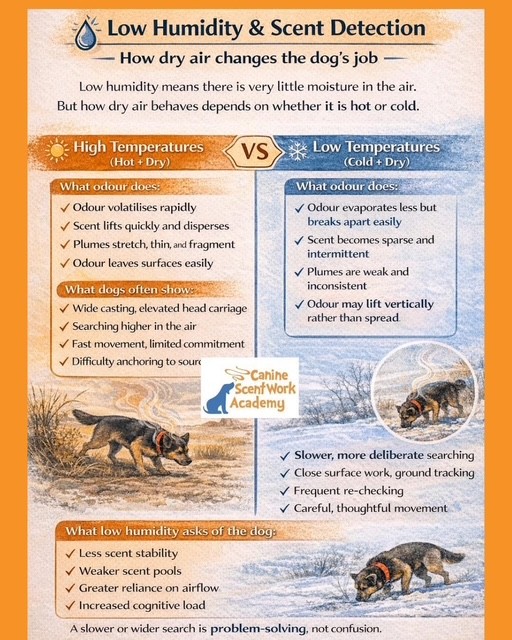
Low humidity means there is very little moisture in the air. Without moisture to support odour particles, scent becomes lighter, less stable, and harder to hold, regardless of temperature.
But temperature still matters.
🌞 Low humidity in high temperatures (hot + dry)
This is one of the most challenging scent environments.
What odour does:
- Odour volatilises rapidly.
- Scent lifts quickly and disperses.
- Plumes stretch, thin, and fragment.
- Odour leaves surfaces easily.
🐕 What search behaviour dogs often show:
Wide casting and elevated head carriage. Searching higher in the air. There maybe quicker movements trying to grab hold of teeny pieces odour information and more difficultly in honing into source.
🥶 Low humidity in low temperatures (cold + dry)
Cold dry air creates a very different, but equally demanding picture.
What odour does:
- Odour evaporates less but breaks apart easily.
- Scent becomes sparse and intermittent.
- Odour plumes are weak and inconsistent
- Odour may lift vertically rather than spread
🐕🦺 What search behaviour dogs often show:
Slower, more deliberate searching. Close surface work and ground tracking and frequent re-checking and more considered, thoughtful movement
In these conditions the dog is working with very limited information.
🐕 What low humidity asks of the dog, in both hot and cold conditions, low humidity means:
- Less scent stability
- Weaker scent pools
- Greater reliance on airflow
- Increased cognitive problem solving
What this means for handlers,
- Likelihood is the search may take longer.
- Take a breath and enjoy the process without adding pressure to your dog.
- Reinforce effort.
- Allow the dog to build up an odour picture in these more challenging conditions
Low humidity doesn’t remove odour it’s still there, but the moisture isn’t, so the movement and settling is limited and the picture not as clear.
The quiet takeaway is you and your dog are there, ready to take on a search challenge. You can’t control the environment, but you can observe, support and enjoy your dog taking on the challenge, whatever the outcome.
Mandy Rigby – Founder & Instructor
Canine Scentwork Academy